The two final lectures require work in class on modeling elementary processes.
Step 1: Apply the example described in the Greek manual
Step 2: BPMN in a nutshell (by S. White, IBM)
Step 3: Process patterns
Step 4: A real case
--petros
Wednesday, 6 February 2008
9th and 10th lecture: process management in vivo
0
comments
Labels:
lectures

Saturday, 2 February 2008
8th lecture: from strategic to process managament
Lecture 8 makes the transition from strategic management to process management. Business processes are the key instrument to:
- Decompose firms’ value chains into networks of activities
- Organize them effectively and efficiently (by measuring and evaluating firm’s performance and by constantly re-designing firm’s process architecture according to its strategic goals and competitive advantage-seeking strategic decisions).


- Lecture notes: Download my presentation from here (ppt file)
- Readings: An introduction to BPMN by Stephen White (IBM) + a short manual in greek of Intalio BPMS Designer 5.0
- Do you need more information on Intalio BPMS Designer 5.0 and how to use it in order to model business processes? Please go there!
- Please visit frequently the Course Repository!
--petros
0
comments
Labels:
lectures
Saturday, 19 January 2008
7th lecture: strategic implementation and consumer-centered strategy
Lecture 7 discusses quickly the organizational aspects (organizational structure design) of strategic management: strategy is formed somehow at the top of SBUs and within the corporate management bodies, so the configuration of an organization towards implementing a strategy becomes a complex task that involves much more constituents than any previous stage of the strategic management process.
But mainly, this Lecture focuses on the Delta Model strategic framework that: a) places the customer at the center of management, b) integrates strategy with execution through the concept of Adaptive Process.
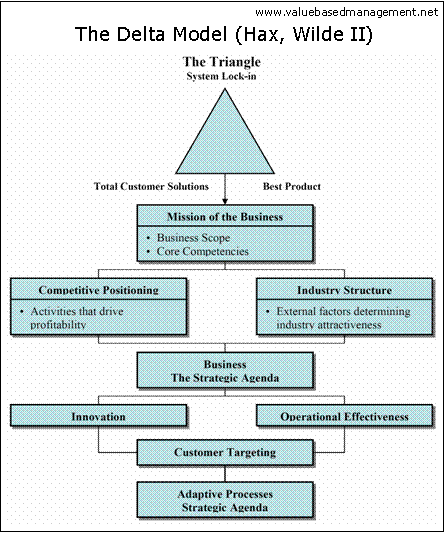
- Lecture notes: Download my presentation on strategy implementation from here (ppt file) and two presentations on Delta Model from Professor A. Hax f(MIT) rom here (presentation 1, presentation 2)
- Readings: Course Textbook Chapter 8 (Organizing for Success) + a A. Hax' paper entitled: "The Delta Model -- Toward a Unified Framework of Strategy" (please click here)
- Please visit frequently the Course Repository!
0
comments
Labels:
lectures
Thursday, 10 January 2008
6th lecture: strategic choice (part II)
Lecture 6 continues on Strategic Choice by focusing on the following themes:
- Transition from Strategic Analysis Process to Strategic Choice
- Achieving competitive advantage / hypercompetition (strategy at the SBU Level)
- Achieving competitive advantage / collaboration (strateg at the SBU Level)
- Diversification (strategy at the Corporate Level)
- Managing Portfolio (strategy at the Corporate Level)
- Corporate Parenting (strategy at the Corporate Level)
- Strategy Development: Directions and Methods (Internal Development, M&A, JD&SAs)
Lecture 6 uses a number of case-studies to highlight critical issues related to decision choice [source: Prentice Hall, 2008, Strategic Management and Competitive Advantage: Concepts and Cases: International Edition, 2/E, Jay Barney and William S. Hesterly]:
- Vodafone's acquisition strategy as a source of competitive advantage
- L'Oreal's Growth Strategy
- The Launch of the Aygo by Toyota -- a strategic alliance generating sustainable competitive advantage
- Readings: Download Vodafone's Acquisition Strategy case study, L'Oreal's Growth Strategy case study, Toyota's Aygo case study; also: a presentation on hypercompetition (ppt file), from R. d'Aveni & R. Gnuther (from here)
--petros
0
comments
Labels:
cases,
lectures
Monday, 7 January 2008
Happy New Year!
My best wishes for a creative, productive and peaceful 2008!
--petros
ps. New Year's Technology Trends from BBC: Enjoy it!
0
comments
Labels:
food-to-thought
Wednesday, 12 December 2007
5th lecture: strategic choice (part I)
Fifth Lecture brings strategic management to life as the course moves from Strategic Analysis to Strategic Choice . Various alternative types of strategies, broad and narrow, are defined and exemplified. Guidelines are presented when different types of strategies are most appropriate to pursue.

- Lecture notes: Download my presentation from here (ppt file)
- Readings: Course Textbook Chapter 5, 6 and 7 (Business-Level Strategy, Corporate-Level and International Strategy, Directions and Methods of Development)
- Please visit frequently the Course Repository!
0
comments
Labels:
lectures
Friday, 7 December 2007
4th lecture: internal analysis
Lecture 4 focuses on identifying and evaluating a firm’s strengths and weaknesses in the functional areas of business, including management, marketing, finance/accounting, production/operations, research and development, and management information systems. Relationships among these areas of business and the strategic implications of important functional area concepts are examined. Strategies are formulated that take advantage of an organization’s internal strengths and improve upon weaknesses. The Resource-Based View (RBV) of strategic management is introduced as well as the Value Chain Analysis (VCA) concept. In such a context, the competitive advantage and superior performance of an organisation is explained by the distinctiveness of its capabilities.
The importance of resources and competences, in terms of creating competitive advantage, is explained in depth through Apple's iTunes case [source: Prentice Hall, 2008, Strategic Management and Competitive Advantage: Concepts and Cases: International Edition, 2/E, Jay Barney and William S. Hesterly].
- Lecture notes: Download my presentation from here (ppt file)
- Readings: Course Textbook Chapter 3 and 4 (Strategic Capability & Expectations and Purposes) + Download (from here) a related case study entitled "Apple’s iTunes: Changing the Face of Online Music Retailing"
- Please visit frequently the Course Repository!
--petros
0
comments
Labels:
cases,
lectures
Wednesday, 28 November 2007
3rd lecture: external analysis (part II)
Hello,
Lecture 3 continues on external analysis methodologies by investigating the exact influence of eacx of Porter's Five Forces. It addresses issues such as:
- Rivalry is stronger when...
- The most common forms that entry barriers can take...
- The threat that substitutes pose to an industry's profitability depends on..
- The most important determinants of buyer power are...
- The definition of supplier power as the mirror image of buyer power...
- Readings: Lecture 3 uses the case "The Global Pharmaceutical Industry" as background material for applying Porter's analysis (see Lecture 2).
--petros
0
comments
Labels:
cases,
lectures
Wednesday, 21 November 2007
2nd lecture: external analysis (part I)
Hello,
Lecture 2 examines the tools and concepts needed to conduct an external strategic-management industry analysis (sometimes called environmental scanning or external audit). An external analysis focuses on identifying and evaluating trends and events beyond the control of a single firm, such as increased foreign competition, demographic or cultural changes and, generally, macro-environment influences. An external analysis reveals key opportunities and threats confronting an organization, so managers can formulate strategies to take advantage of the opportunities and avoid or reduce the impact of threats. This lecture presents a practical framework and guidelines for gathering, assimilating, and analyzing environmental information. The Industrial Organization (I/O) view of strategic management is introduced through an original analysis of "Five Forces Framework".
- Lecture notes: Download my presentation from here (ppt file)
- Readings: Course Textbook Chapter 2 (The Environment) + Download (from here) a related case study entitled "The Global Pharmaceutical Industry" -- see also, Textbook/Part Case Studies: pp. 620-637
- Please visit frequently the Course Repository!
--petros
0
comments
Labels:
lectures
Sunday, 18 November 2007
1st lecture: introduction
Hello,
The introduction lecture provides an overview of organizations purposes and strategic / process management objectives. A practical, integrative model of the strategic-management process is introduced. Basic activities and terms in organizational economics and strategic management are defined. A vocabulary of strategy is discussed (follows).
 source: Course Textbook
- Lecture notes: Download my presentation from here (ppt file) or here (pdf file)
- Readings: Course Textbook Chapter 1 (Introducing Strategy) + Download (from here) an interview with Richard Rumelt explaining the value of strategic thinking (published in McKinsey Quarterly)
0
comments
Labels:
lectures
students' evaluation: contributing factors
- Class Participation (10%)
- Three (3) Tests during the semester (10% each)
- Final Exam (60%)
0
comments
Labels:
about this course
what you will learn in this course
A set of fundamental concepts for understanding the process of how businesses (what is this exactly?) organize to meet the objectives they fix:
- Strategy and strategic management
- Position in the competition and sustainable competitive advantage
- Integrate strategy with execution
A set of concepts and tools for understanding the process of how business coordinate the activities involved in business processes:
- Business process analysis and design
- Business Process Management (BPM)
0
comments
Labels:
about this course
about this course
This course focuses on some of the important current issues in strategic management and process management. It is intended to provide the students with an intellectual framework that will guide the formulation and implementation of corporate strategies - with emphasis to strategies that fit with the emerging collaborative business enviroment and leverage the potential of IT technologies.
The course utilizes lectures and independent reading. The readings (textbook chapters and papers) are primarily drawn from strategic management literature, economics of technical change, behavioral and organizational economics, and from research conducted in engineering and business schools environments. A few of the journal articles are quite difficult. The appropriation from the students of the content of these book chapters and papers will be considered as the essential part of the student evaluation process.
Course Meeting Times Lectures: Ten (10) Lectures
- One Lecture / Week
- Three Hours / Lecture
0
comments
Labels:
about this course
Subscribe to:
Comments (Atom)


